Jennifer Lauren Martin is an artist-filmmaker and co-director of not/nowhere a Black and POC-led artist workers co-op in London which focuses on analogue film (16mm and Super 8). Martin’s practice exists within a fine art and film context, working with moving image, performance, sculpture, photography and installation. They are also a writer and academic. For Open City Documentary Festival 2026 Martin has curated Analogue in Depth, a day-long seminar broken into three sections; a talk, panel discussion and film screening.
Taylor Le Melle (co-founder of not/nowhere and co-director for many years) was the one who first put the question of the seminar ‘why should black filmmakers shoot on analogue?’ to Jennifer Lauren Martin. “That was kind of the way that she was phrasing this question [to Martin, the co-op and those in their orbit], why should we want to shoot analogue? We're doing this thing, we're invested in this thing, but why is it actually of benefit for us?” Martin tells me. “I want to talk about why we should shoot analogue, but I also want to talk about things that are happening within the kind of current circulation of films that are phrased as, termed as Black films.”
It took some time but during not/nowhere’s autumn 2025 season, Heirlooms, curated by Samara Addai (not/nowhere co-director), Martin gave a talk moderated by Le Melle. It was an opportunity to collaboratively reflect and consider the question, ‘why should black filmmakers shoot on analogue?’ and “also talk about things that are happening within the current circulation of films that are termed as black films.”
Martin prepared some texts and “a kind of survey of films I wanted to talk about” and slides of very specific technical specifications of different films, and then spoke quite freely about their selection. There was “a somewhat open relationship to the audience, or it was left to be open in a way, and when we got to the proper Q&A section that became really engaged in terms of this kind of back and forth.”
“It felt really rich” they tell me, the audience was overwhelmingly Black, intergenerational and full of Black film programmers, actors, artists, people bringing their family members and elder artists. “It was really special [it] kind of felt like magic.” Film programmer Abiba Coulibaly was in the audience, and made the connection between Martin and Open City to re-visit and continue this collaborative thinking.
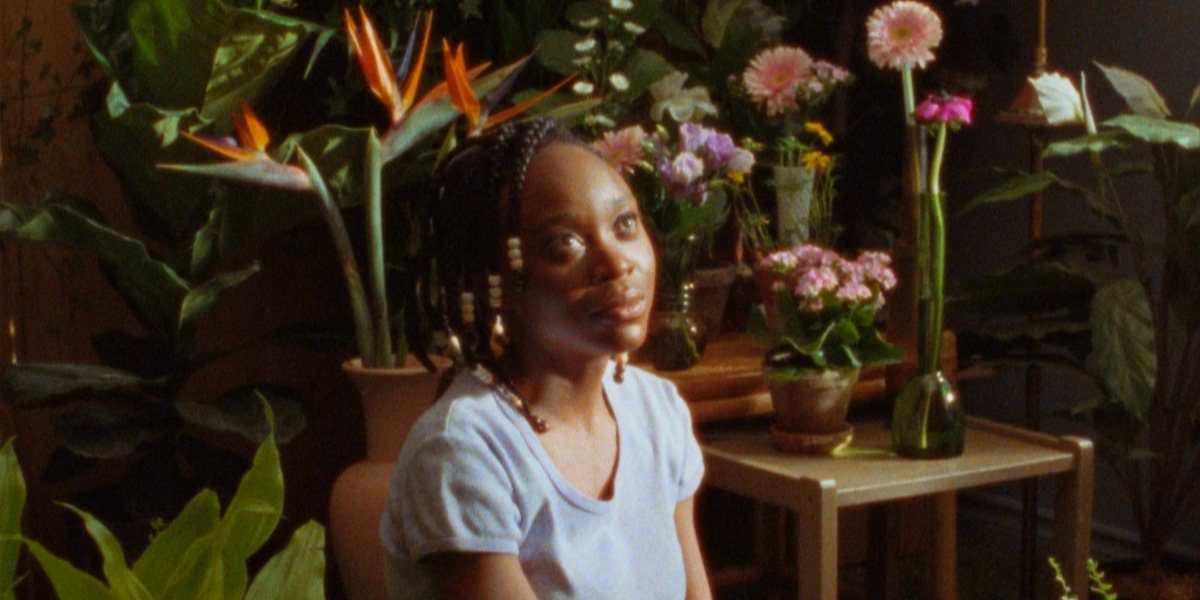
This next iteration is longer, and as Martin describes it offers a “separate space where we could have a real kind of productive dialogue that would also be open to the audience in some ways” – it includes a discussion with Martin, filmmakers Hope Pearl Strickland and Martina (Judah) Attille, curator Matthew Barrington and is moderated by Coulibaly. In the evening there is a film screening, “to give people a bit more to chew on in terms of having actual work that we can look at.”“The [film] programme is a way to kind of take the ideas and put it against something.” One of the films is Cette Maison released in 2022 and directed by Miryam Charles. “It [Cette Maison] felt like a great choice for so many reasons.” Martin says. “I think it is such a wonderful film and it is so invested in thinking about storytelling, about its images and about impossibility…and it's so kind of playful with its materials as well, in terms of pointing between things. It really felt like the perfect film to feature for the screening.”
The accompanying shorts, Chronicles of a Lying Spirit (dir. Kelly Gabron), Men Who Swallow Themselves in Mirrors (dir. Sable Elyse Smith) and Wide Open in the Shape of an Enormous Fan (work-in-progress) (dir. Jennifer Lauren Martin), all have a material richness but for Martin it’s not only about the format, it’s also about the image politic, and “the way the image is being taken up.”
Finally, I ask Martin about their own relationship to analogue film, “I appreciate the attention and the time, that real relationship to duration and to materiality. I think especially in a time in which we are being increasingly dematerialised, divorced from process, divorced from kind of hand-making, and pushed increasingly towards digital and abstracting technologies, I really appreciate a process that is different to that. I like feeling my hands on something.” This thinking is both part of their process and practice, and speaks to the selection of the other films in the programme.
Analogue in Depth is part of Open City Documentary Festival 2026, it takes place on Friday 17 April, more information can be found herewith tickets to the film screening here.
Tomiwa Folorunso
